
CROSS-FACULTY RESEARCH HUB (with Arts Faculty/humanities base)
Title: CHINA, HUMANITIES, AND GLOBAL STUDIES
Welcome to the webpage for the research hub and virtual center, China, Humanities, and Global Studies (CHAGS). It exists to foster the inter-disciplinary, theoretically-informed study of the global conjuncture, one that so powerfully and self-evidently features the impacts and potentials of a rising China since the 1970s, as well as the “second handover” of Hong Kong as it enters a new era of integration with the mainland. It is based in the Arts Faculty, but welcomes humanities scholars working in the social sciences. By ‘global conjuncture,’ we refer to the specific ensemble of cultural, economic, and social forces that make up our given period or ‘moment’ of the global situation, as well as its political outcomes and new realities. What is China’s and Hong Kong’s place in this, and in what ways?
This hub supplements and complements the valuable empirical, area-based, quantitative, policy, and other work on China, Hong Kong, Asia, and globalization being done at HKU. It seeks to produce and support humanistic, interpretive, and reflective work that builds on concrete and contextualized studies yet aspires to a more global reach.
This hub was also created – it is important to note -- to develop and enhance our professional and intellectual ties with mainland-based scholars and programs that, likewise, are working on the complex, urgent, and fascinating questions subtending China in/and globalization and the new conjuncture.
This hub takes the new times we live in seriously, beginning with the rise of China and the era of de-colonization, as well as the aftermath of the Soviet interregnum and thence the relative decline of the traditional Western powers, including their command of the media and knowledge-production. But the question remains as to how best to describe and understand the new global conjuncture or theatre. And how should we interpret and evaluate or theorize this new global and geo-political reality? This period is in flux even as it is also crisis-ridden. It behooves us to support and foster work, in the SAR and the mainland, that attempts to describe and know the distinctive shape of this new conjuncture in any of its concrete aspects. This is precisely the purpose of the hub and its future activities. And it is, as well, the traditional role and function of the humanities, criticism, and the interpretive social sciences.
Organization:
The CHAGS Hub is directed by Prof. Daniel F. Vukovich (School of Humanities and Chair of Comparative Literature), in consultation with an advisory board of Hong Kong University professors in the humanities broadly defined. All faculty members with shared interests are welcome to join the activities of the hub as well as share ideas and suggestions for events, activities, and initiatives.
Research Themes:
The hub will be gently organized around several research themes and projects within the rubric of China, the humanities, and global studies. These projects will be led by renowned scholars alongside dedicated researchers and earlier career faculty.
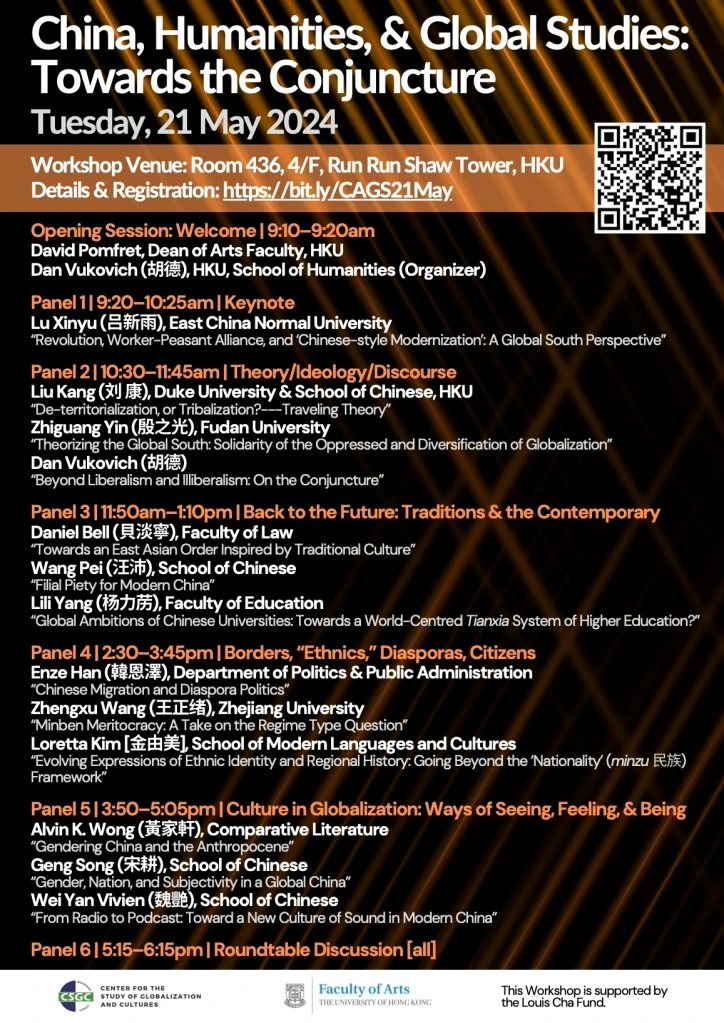
- On the Conjuncture: The World in/and China
- Tradition and Contemporary China
- Borders, Identities, Citizens
- Global Culture and Global China
Advisory Board, HKU: (May 2024):
Prof. Daniel Vukovich, Director
Prof. Song Geng, School of Chinese
Prof. Daniel Bell, Faculty of Law
Prof. Loretta Kim, School of Modern Languages and Cultures
Prof. Enze Han, Department of Politics and Public Administration, Faculty of Social Sciences
Prof. David Palmer, Department of Sociology and Hong Kong Institute for the Humanities and Social Sciences (IHSS)
Prof. Wang Pei, School of Chinese
Advisory Board (China):
Professor Yan Hairong 严海蓉, Tsinghua Institute for Advanced Study in Humanities and Social Sciences and Professor at the Department of Sociology
Professor Lyu Xinyu 吕新雨, East China Normal University, School of Communication, Dean of the International Communication Research Institute
Professor Cui Zhiyuan 崔之元, Tsinghua University, School of Public Policy and Management and Institute for Advanced Study in Humanities and Social Sciences
Professor Yin Zhiguang, 殷之光, Fudan University, School of International Relations and Public Affairs,
Professor Liu Shih-Ding 劉世鼎, University of Macau, Department of Communication, and Sr. Research Fellow at the Institute of Advanced Studies
Professor Wang Hui 汪晖, Tsinghua University, Departments of Chinese and History, Director of the Institute for Advanced Study in Humanities and Social Sciences
Advisory Board (Abroad)
Prof. Meng Bingchun (孟炳春), LSE, Media and Communications
Prof. Jamie Peck, Univ. British Columbia, Dept. of Geography
Prof. Catherine Liu (劉慧心), UC Irvine, School of Humanities, Film and Media
Jan Nederveen Pieterse, UCSB , Dept. of Global Studies
Prof. Jon Solomon (蘇哲安), Jean Moulin Lyon 3 University, Language and Literature
Prof. Ban Wang (王斑), Stanford University, East Asian Languages & Literature
Prof. Fang Yan (杨帆), Univ. Maryland, Media and Communication Studies
Prof. Zhong Xueping (钟雪萍), Tufts Univ., International Lit. and Cultural Studies
Upcoming Event
cfp: “After the Rise: China in/and the Global Conjuncture.”
Date: June 19-21, 2026 (to be confirmed)
Venue: The University of Hong Kong
Organized by the CHAGS Research Hub @https://arts.hku.hk/research/CHAGS

Funded via HKU Arts Faculty Conference Grant.

Co-sponsored by Fudan University.

• Travel support available for non-local participants.
Outcomes: special issue (journal) and/or edited volume [in 2027, tba]
Expressions of interest & queries welcome.
Conference language: English, but bilingual.
500 word ABSTRACTS by Feb 27, 2026 to:
chags.hku@gmail.com or vukovich@hku.hk
“The crisis consists precisely in the fact that the old is dying and the new cannot be born ; in this interregnum a great variety of morbid symptoms appear.” Antonio Gramsci [1930].
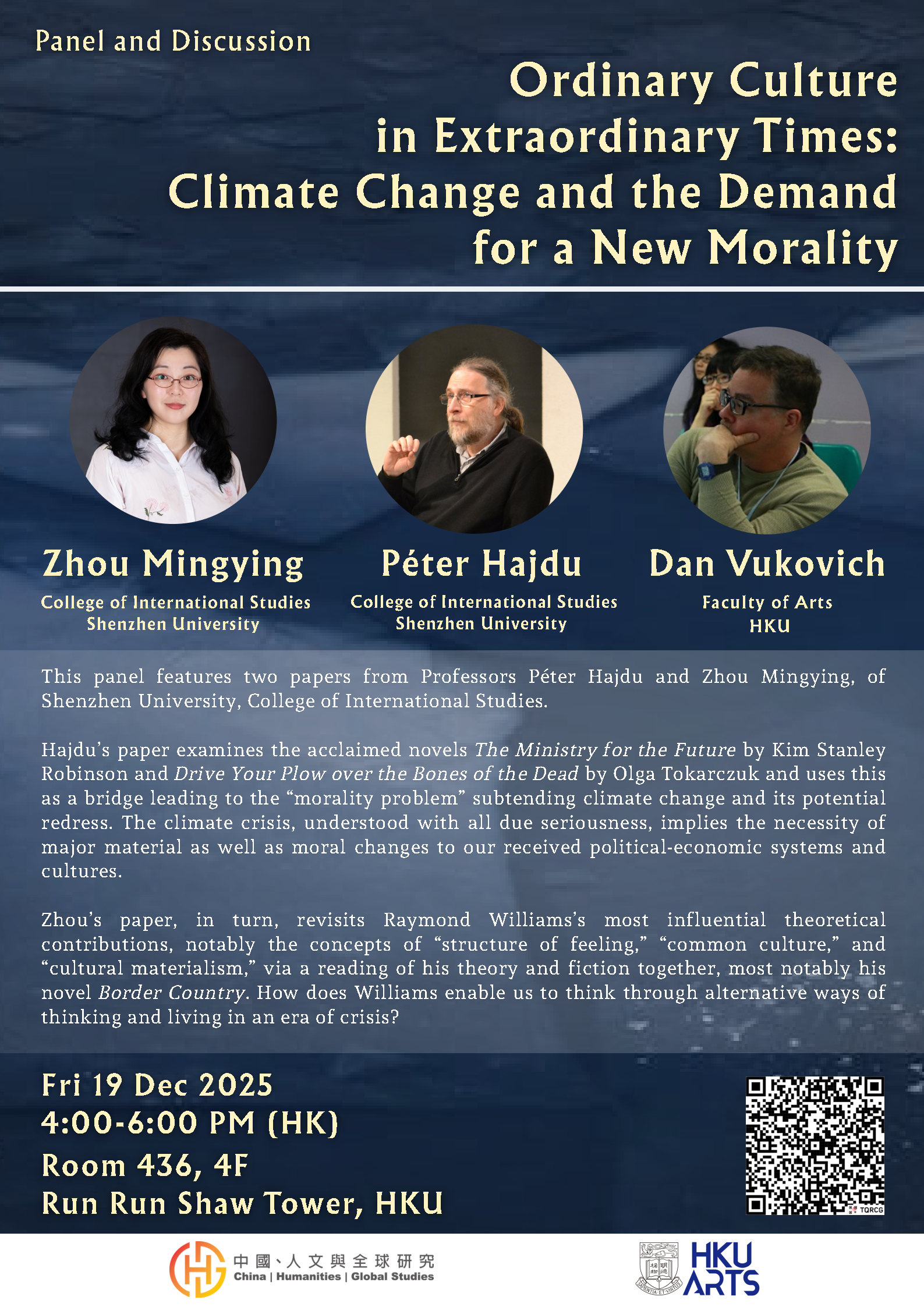
Structure of Feeling, “New Times,” Conjuncture
If we hold one thing in common globally, it is the felt sense that we are in a new era that represents a rupture, or break, from the recent past. It is a mood, a feeling, but it has its roots. It reflects world historic changes in the order of things, on top of the manifold, internal crises within and across nations and societies. Whether conceived as interregnum or as a new conjuncture (which implies an outcome), these are new times. This conference seeks to better understand them. We live after the rise of the PRC and during the relative decline of the US-West and its normative powers. What comes next is uncertain, but a return to the past is impossible. How to understand, theoretically and concretely, this new period? A period in which the PRC is absolutely central, and yet cannot and moreover does not wish to constitute a new centrifugal force at the center of the world. A period in which we lack a ready-to-hand language to describe the conjuncture (capitalism vs socialism, authoritarianism vs freedom, e.g.) and do not need the arthritic jargonizing of bad cultural studies or ‘1960s’ (Franco-American) theory. As an old world dies, it takes with it the hippies, the boomers, the weedy ‘new left’ and an epoch of simple-minded anti-statism. Likewise, for the Occidentalist fever dreams of the global 1980s in China, Hong Kong, and elsewhere.
Ours is a period and context further defined by an increasing multi-polarity (via a vis the global south and, e.g., the Belt Road, BRICS,
ASEAN) as well as the demise of neo-liberalism. The shady aftermath of that political-economic movement remains. Brexit, global Trumpism, riots, xenophobia, anarchic yet live-streamed protest movements/riots, conspiracism, tariff and war mongering, Sinophobia, and more, are part of that aftermath. Neo-liberalism exists as a zombie, much like its ancestral discourse from the Enlightenment. Decades of austerity, waves of labor-displacing new technology, new media trumping knowledge production, the hollowing out of social democracy and community, staggering inequalities, all help characterize the present. But so does China.
For all its own inequalities and problems, the PRC has mostly outflanked neo-liberalism and pursued its own, globally embedded, path of development. It has lifted millions and millions of people out of poverty, radically improved food availability (to pick an untrendy ‘social indicator’), highly developed its technology, and refused to become ‘the same’ as the US-West. It has retained its sovereignty and moreover its state capacity, and moved on its own foundations. This does not mean it has ‘won’ so much as survived (and in many ways thrived). Surely there are lessons to be learned from this, and its ‘example’ has not gone unnoticed worldwide. What however might these be, and moreover what do they tell us about the new, nascent period? What have we learned, and what are we learning?
We seek neither to mourn nor to celebrate this new conjuncture. We seek to better describe and explain it, and the changes (and potentials) it represents, politically, intellectually, economically, and sociologically. Dialectics, not debunking.
This new conjuncture comes after whatever the meanings and ambitions of the 20th century were. To arrive at an analysis of it, we must think within and against our received discourses and knowledge about what constitutes development, progress, the future, the meaning of society, growth, globalization, and politics. This applies East and West, North and South, be it the anarchist sublime or liberal catechisms of the West, or the blind faith in free trade, growth, and high tech elsewhere.
The period we inhabit demands renewed, re-energized thought and criticism, without which we fail to adequately understand either the new world that struggles to be born or the morbid symptoms and positive potentials of the interregnum.
[Lukacs, Sartre, Mariátegui, Colletti, Cesaire, Althusser, Williams, Gramsci, Mao, Dussell, others]