
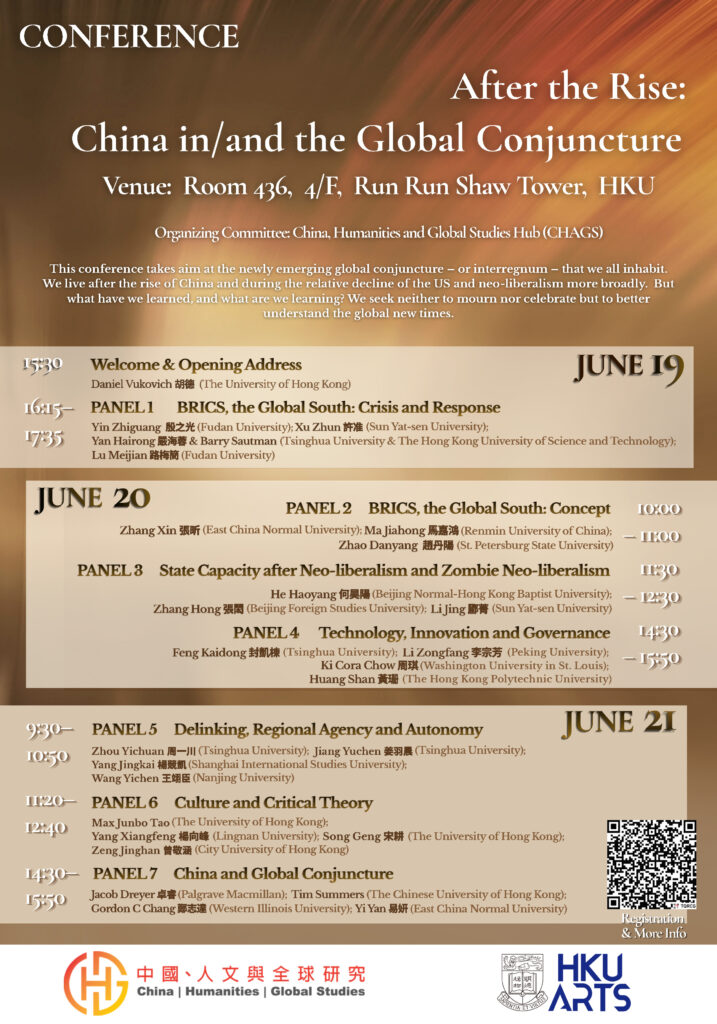
Date: June 19-21, 2026
Venue: Room 436, 4/F, Run Run Shaw Tower, The University of Hong Kong
Speaker Biographies
Live Streaming Link
Organized by the CHAGS Research Hub @https://arts.hku.hk/research/CHAGS
Funded via HKU Arts Faculty Conference Grant.
Co-sponsored by Fudan University.

- Travel support available for non-local participants.
Outcomes: special issue (journal) and/or edited volume [in 2027, tba]
Expressions of interest & queries welcome.
Conference language: English, but bilingual.
500 word ABSTRACTS by Feb 27, 2026 to:
chags.hku@gmail.com or vukovich@hku.hk
“The crisis consists precisely in the fact that the old is dying and the new cannot be born ; in this interregnum a great variety of morbid symptoms appear.” Antonio Gramsci [1930].
Structure of Feeling, “New Times,” Conjuncture
If we hold one thing in common globally, it is the felt sense that we are in a new era that represents a rupture, or break, from the recent past. It is a mood, a feeling, but it has its roots. It reflects world historic changes in the order of things, on top of the manifold, internal crises within and across nations and societies. Whether conceived as interregnum or as a new conjuncture (which implies an outcome), these are new times. This conference seeks to better understand them. We live after the rise of the PRC and during the relative decline of the US-West and its normative powers. What comes next is uncertain, but a return to the past is impossible. How to understand, theoretically and concretely, this new period? A period in which the PRC is absolutely central, and yet cannot and moreover does not wish to constitute a new centrifugal force at the center of the world. A period in which we lack a ready-to-hand language to describe the conjuncture (capitalism vs socialism, authoritarianism vs freedom, e.g.) and do not need the arthritic jargonizing of bad cultural studies or ‘1960s’ (Franco-American) theory. As an old world dies, it takes with it the hippies, the boomers, the weedy ‘new left’ and an epoch of simple-minded anti-statism. Likewise, for the Occidentalist fever dreams of the global 1980s in China, Hong Kong, and elsewhere.
Ours is a period and context further defined by an increasing multi-polarity (via a vis the global south and, e.g., the Belt Road, BRICS,
ASEAN) as well as the demise of neo-liberalism. The shady aftermath of that political-economic movement remains. Brexit, global Trumpism, riots, xenophobia, anarchic yet live-streamed protest movements/riots, conspiracism, tariff and war mongering, Sinophobia, and more, are part of that aftermath. Neo-liberalism exists as a zombie, much like its ancestral discourse from the Enlightenment. Decades of austerity, waves of labor-displacing new technology, new media trumping knowledge production, the hollowing out of social democracy and community, staggering inequalities, all help characterize the present. But so does China.
For all its own inequalities and problems, the PRC has mostly outflanked neo-liberalism and pursued its own, globally embedded, path of development. It has lifted millions and millions of people out of poverty, radically improved food availability (to pick an untrendy ‘social indicator’), highly developed its technology, and refused to become ‘the same’ as the US-West. It has retained its sovereignty and moreover its state capacity, and moved on its own foundations. This does not mean it has ‘won’ so much as survived (and in many ways thrived). Surely there are lessons to be learned from this, and its ‘example’ has not gone unnoticed worldwide. What however might these be, and moreover what do they tell us about the new, nascent period? What have we learned, and what are we learning?
We seek neither to mourn nor to celebrate this new conjuncture. We seek to better describe and explain it, and the changes (and potentials) it represents, politically, intellectually, economically, and sociologically. Dialectics, not debunking.
This new conjuncture comes after whatever the meanings and ambitions of the 20th century were. To arrive at an analysis of it, we must think within and against our received discourses and knowledge about what constitutes development, progress, the future, the meaning of society, growth, globalization, and politics. This applies East and West, North and South, be it the anarchist sublime or liberal catechisms of the West, or the blind faith in free trade, growth, and high tech elsewhere.
The period we inhabit demands renewed, re-energized thought and criticism, without which we fail to adequately understand either the new world that struggles to be born or the morbid symptoms and positive potentials of the interregnum.
Keywords, Topics, Prompts (others welcome):
BRICS, Belts, Bandung: Global South or Global Bourgeoisie?
Delinking/De-risking/De-Globalization
State-led Market Economies
“Involution” or neijuan (内卷)
Global Trumpism / Populism
“Illiberalism”
Anti-statism, or, the Left-Right movement
Statism and state-capacity after neo-liberalism/austerity.
Zombie Neo-liberalism, Zombie Liberalism
21st Century Trajectories: What is, what will happen?
20th Century lessons: What happened?
Varieties of Capitalism, Socialism, Republicanism, Democracy
Wars: Hot, Cold, Chips, & Imperial Ambitions
Critical Theory for the New Conjuncture:
- beyond 1968 paradigms, incl. the Americanization of ‘theory.’
- Alternative resources, before and after World War II.
[Lukacs, Sartre, Mariátegui, Colletti, Cesaire, Althusser, Williams, Gramsci, Mao, Dussell, others] - modern and ‘traditional’ Chinese thinkers
When China Does Not Rule the World, But Nor Does Washington
Technology (chips, energy, media, algorithms, AI)
Autonomy and Sovereignty: political projects, or dead-ends?
After Civil Society & After Activism: Whither Participation?
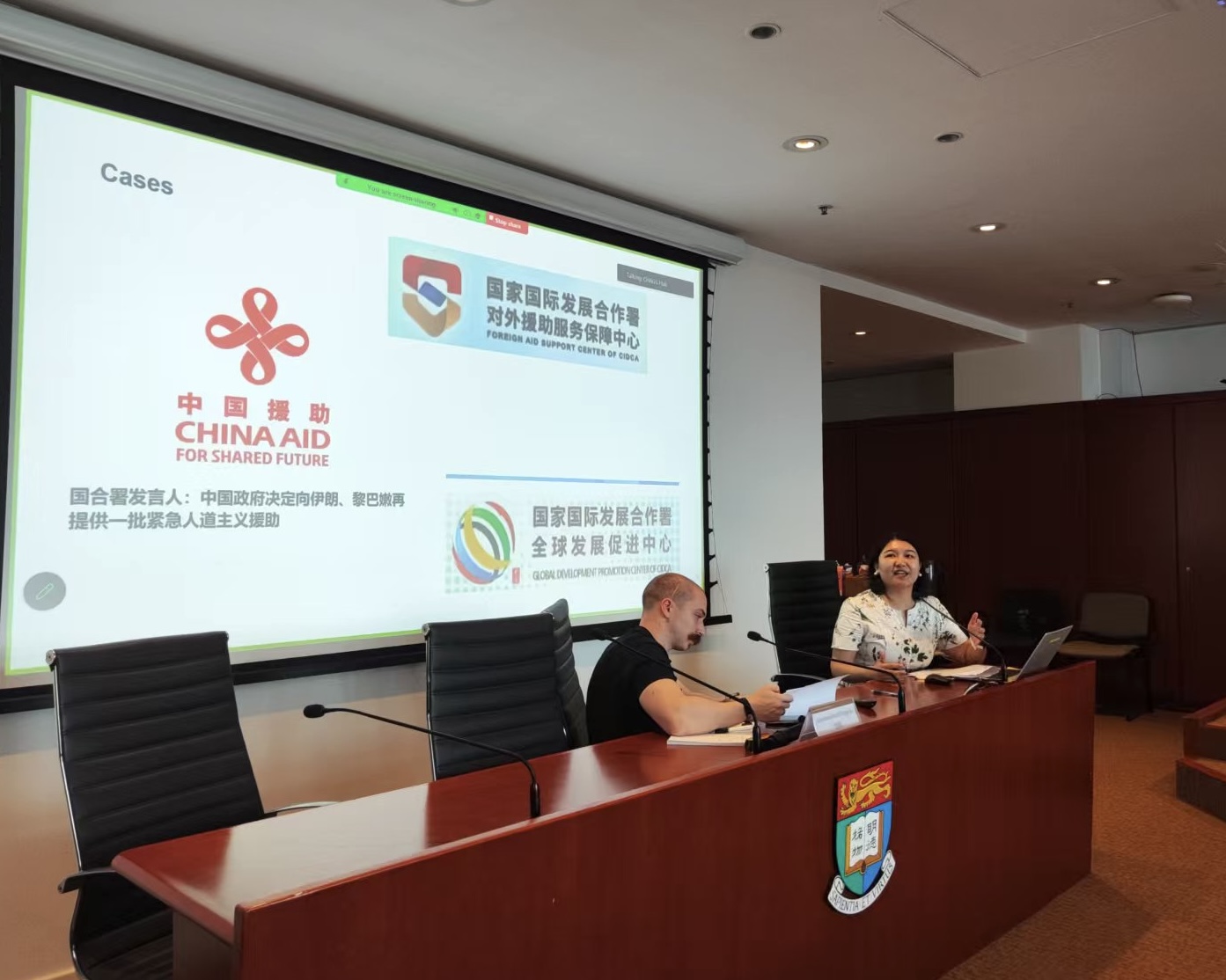
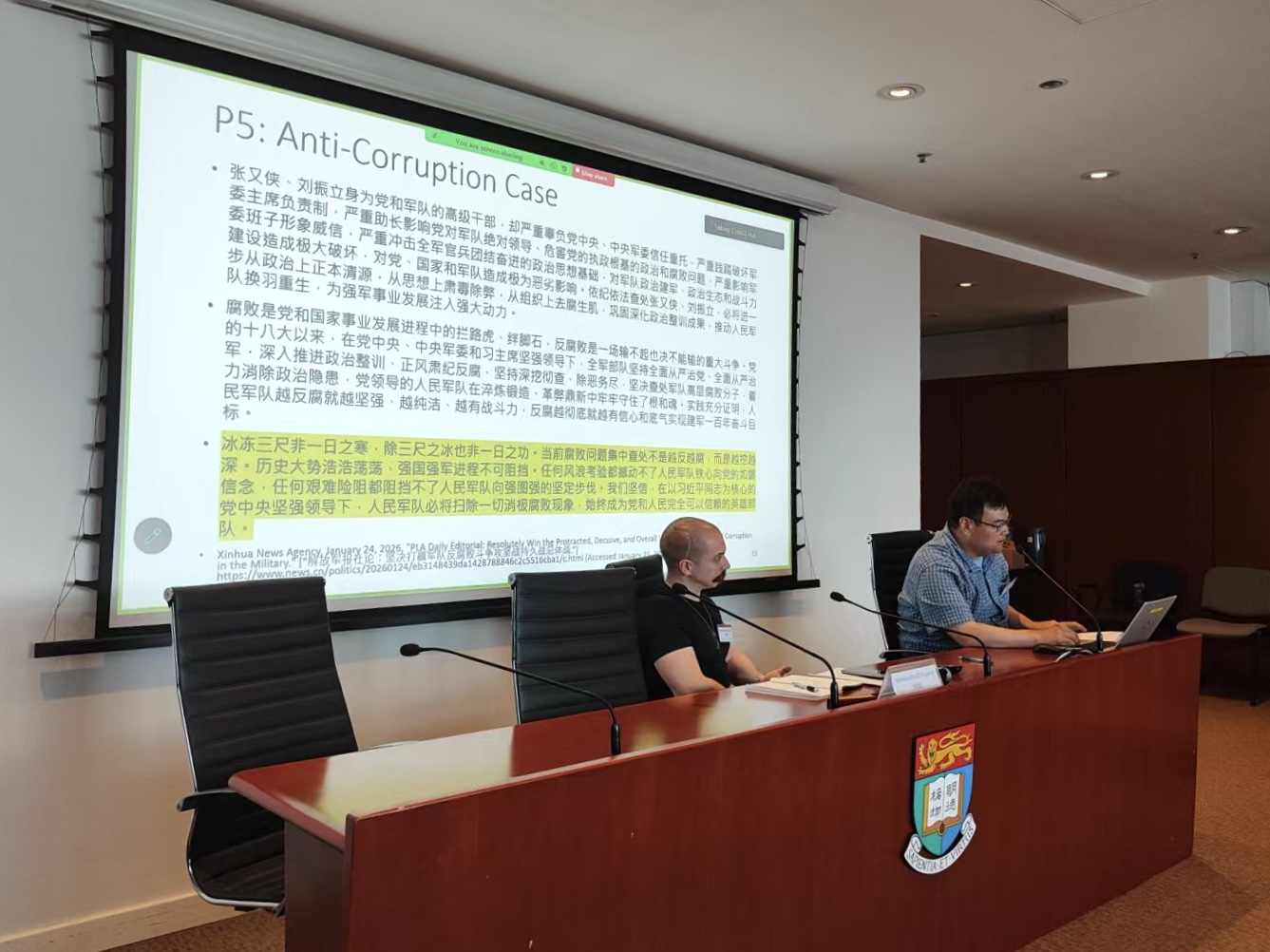
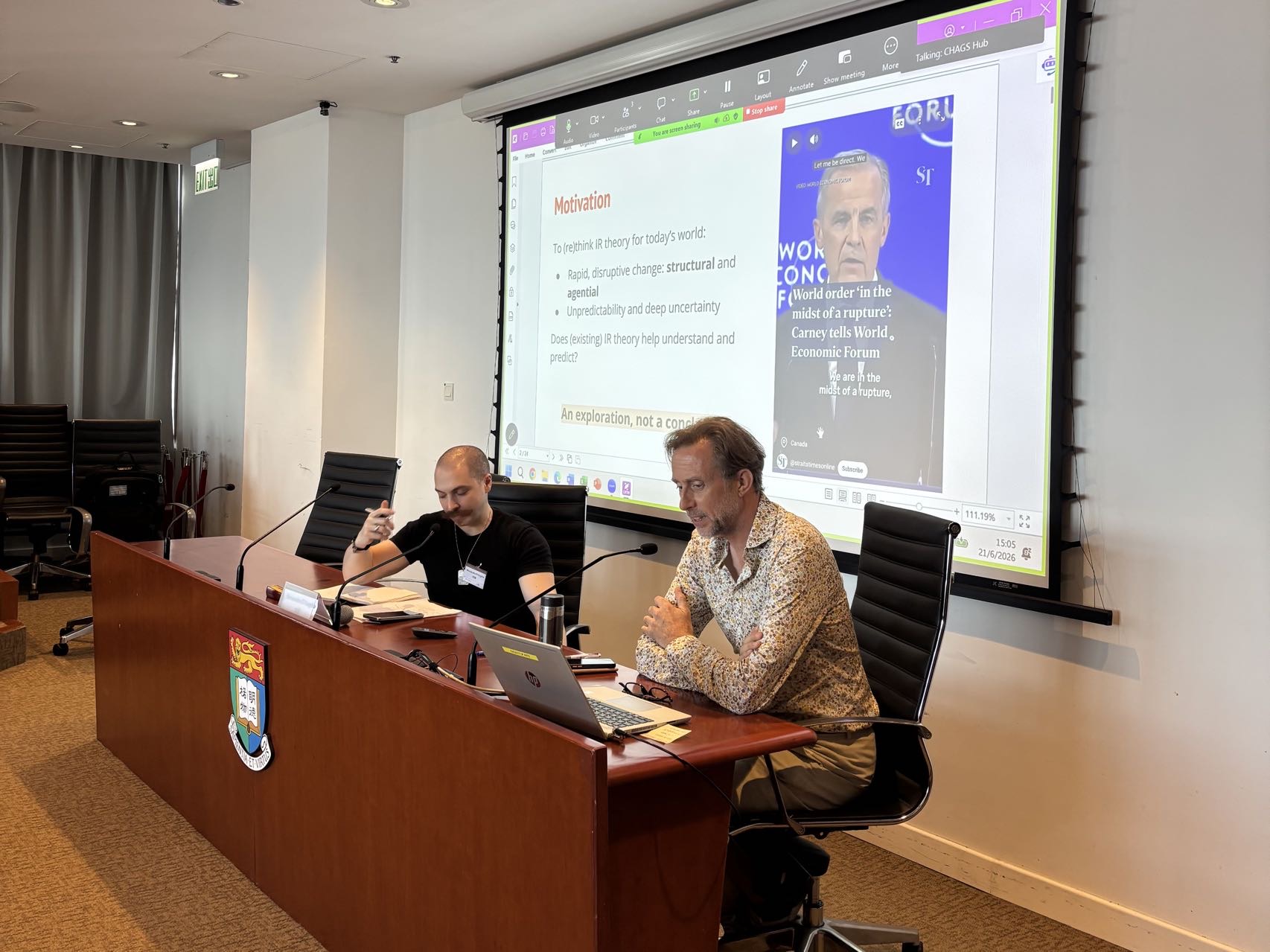
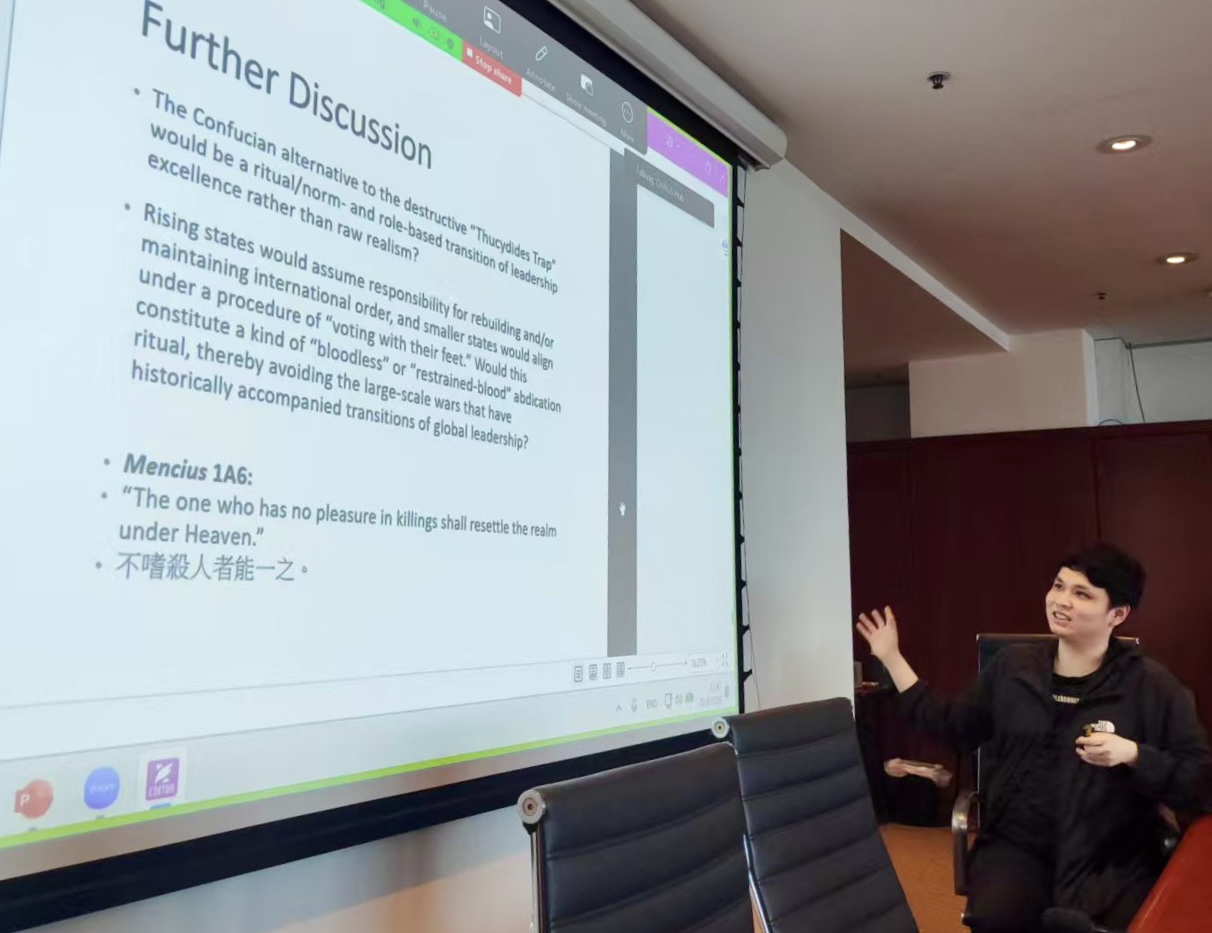
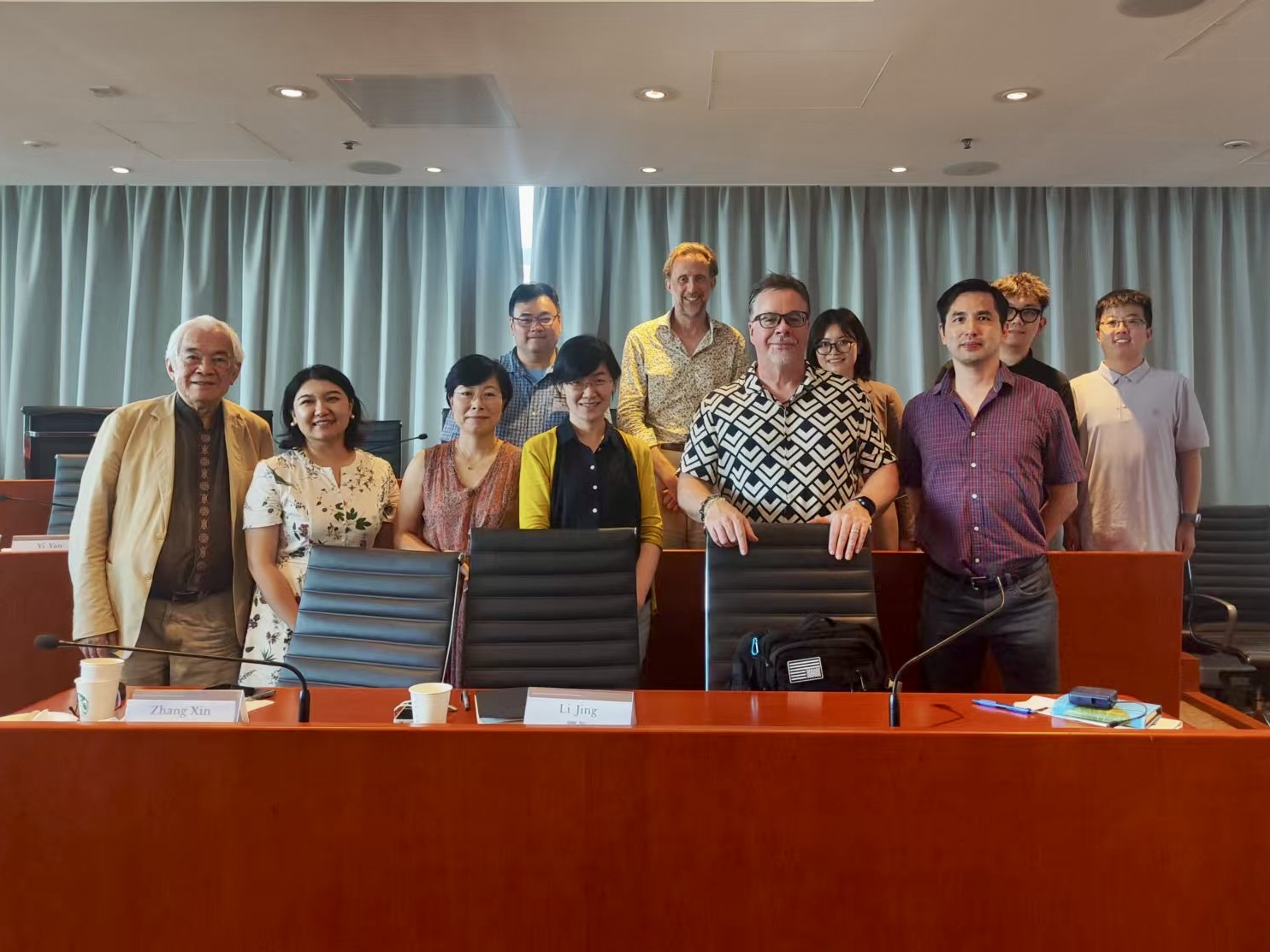
Event Photos