


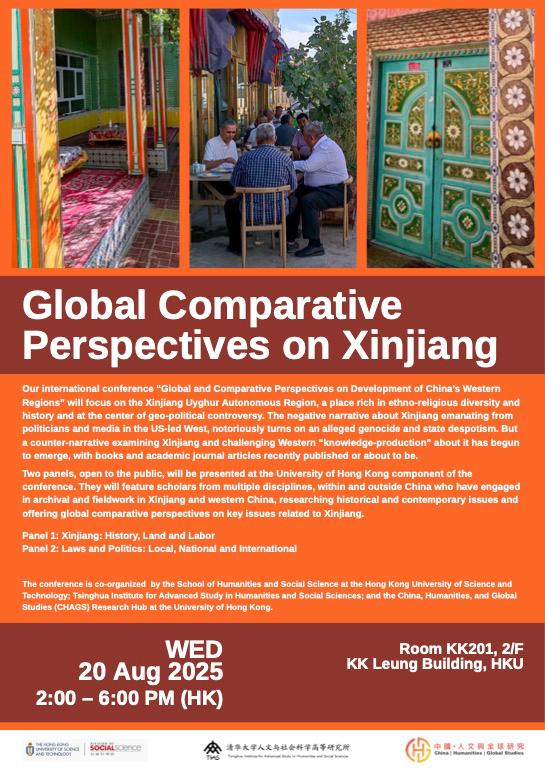
Date: Wednesday, August 20, 2025
Time: 2:00–6:00 pm (Hong Kong Time)
Venue: Room 201, 2/F, KK Leung Building, The University of Hong Kong
Registration: https://hku.au1.qualtrics.com/jfe/form/SV_efgKGoHkYxvHX8O
For a brief overview of the Workshop and speaker bios, click here.
Detailed Panel Information
议题一: 新疆: 历史、土地与劳动
主持人:胡德教授,香港大学
Panel 1: Xinjiang: History, Land and Labor
Panel Chair: Daniel F. Vukovich, Professor, University of Hong Kong
谁是塔里木盆地的早期居民 ——古代新疆的一段历史
杨圣敏,民族学教授 中央民族大学
早在新石器时代,塔里木盆地各绿洲上就已有定居农业。到了公元前几个世纪,关于盆地内居民的情况,就有了比较详细的记载。那以后至今的两千多年来,各绿洲上的居民有多次大的迁徙变化,总体来看,这里从来都是多民族共同生活,不断交融的地方,从来不是单一民族的居地。那么,古代盆地内的民族分布有什么大的变化?谁是塔里木盆地的早期居民呢?历史与考古材料是清楚的。
在公元9世纪中叶以前,塔里木盆地的居民主要有操印欧语系几种语言的“胡人”,古代藏羌语言的羌人和汉语的汉人。公元840年以后,他们与来自蒙古草原的游牧民族,维吾尔人的先民回纥人逐渐融合了。所以说,塔里木盆地自古就是多民族共同生活之地,也是多民族融合之地。这种情况在中国多数边疆地区的历史上都是类似的。
1. Who were the early inhabitants of the Tarim Basin:A History of ancient Xinjiang
YANG Shengmin, Professor of Ethnology, Minzu University of China
As early as the Neolithic Age, settled agriculture had already emerged in the oases of the Tarim Basin. By the centuries before the Common Era, relatively detailed records about the inhabitants of the basin began to appear. Over the subsequent two millennia up to the present, the populations of these oases underwent several major migrations and changes. Overall, this region has always been a place where multiple ethnic groups coexisted and continuously intermingled—never the exclusive homeland of a single ethnicity. So, what were the major shifts in the ethnic distribution within the ancient basin? Who were the earliest inhabitants of the Tarim Basin? Historical and archaeological evidence provides clear answers.
Before the mid-9th century CE, the Tarim Basin was primarily inhabited by “Hu people” who spoke various Indo-European languages, Qiang people who spoke ancient Tibeto-Qiang languages, and Han Chinese who spoke Chinese. After 840 CE, these groups gradually merged with the nomadic peoples from the Mongolian steppe—the Uyghurs’ ancestors, the Huíhé (回纥). Thus, the Tarim Basin has been a land of multiethnic coexistence and integration since ancient times. This pattern mirrors the historical dynamics of many frontier regions across China.
土地与劳动:1980年代以来的新疆棉花生产
林芳菲,副教授,新疆大学
新疆是全球棉花生产的重要地区。近年来,一些西方非政府组织、智库及学者针对新疆棉花生产炮制所谓“强迫劳动”的不实指控。这一说法既无视了自1980年代以来新疆棉花种植业发展的历史脉络,更与客观事实不符。基于官方统计数据及我自2013年至2025年在新疆棉田进行的长时间跟踪田野调查,本研究试图梳理改革开放以来中国新疆棉花种植业发展的历史脉络与现实情况。
新疆棉花种植业的崛起始于改革开放时期,其发展得益于新疆的土地资源优势,也受到国家东棉西迁战略的影响,但更根本的动因在于市场因素和经济效益的驱动。首先,我将结合一个南疆地区新垦棉田的案例,呈现新疆棉田的开垦主要出于农业规模化的考量,绝非所谓的“殖民”,棉田开发过程有维吾尔族与汉族共同参与,甚至维吾尔族起到了更为主导的作用且获得了更高且稳定的收益。其次,1990年代中期至2010年代中期,新疆棉花采摘之所以雇佣季节性拾花工主要受限于进口采棉机与本地棉株的不匹配,并且内地拾花工才是新疆棉花采摘劳动的主力。棉田里,汉族拾花工与维吾尔族拾花工的工资并无太大差异,南疆地区棉农选择招募维吾尔族拾花工主要出于减少路费和降低管理成本的考虑。另外,维吾尔族拾花工大多同样由其家乡的维吾尔族劳务经纪人组织务工。再次,自2010年代中期,大型采棉机已逐渐取代人工拾花。通过对比机器采摘和人工采摘的价格、手采棉与机采棉的收购价格等相关数据,我们不难发现,雇佣拾花工对于棉农而言只能增加成本,并无效益可言,在新疆机器采棉是不可逆的大趋势。这些讨论充分表明,西方所谓“强迫劳动”的说法相悖于改革开放以来新疆棉花种植的发展及转型的事实。最后,我还将分析美国对新疆棉花实施制裁背后的政治经济动因,并尝试揭示塑造美西方编造所谓“强迫劳动”叙事的地缘政治与经济因素。
2. Land and Labor: Cotton Cultivation in Xinjiang since the 1980s
LIN Fangfei, Associate Professor, Xinjiang University
Xinjiang produces 90% of China’s cotton and 20% of the global supply, positioning it as a pivotal player in the international cotton market. In recent years, however, certain Western NGOs, think tanks, and scholars have propagated unfounded allegations of “forced labor” in Xinjiang’s cotton sector. These claims not only ignore the historical development of Xinjiang’s cotton industry since the 1980s but also blatantly contradict reality. Drawing on official statistics and my own extensive field research conducted in Xinjiang’s cotton fields between 2013 and 2025, this study examines the evolution and current realities of Xinjiang’s cotton production. The industry’s growth began during China’s reform era, driven by the region’s natural advantages, national policies supporting westward cotton cultivation, and—most critically—market forces and economic efficiency.
First, I present a case study of newly cultivated cotton fields in southern Xinjiang, illustrating that their development was driven primarily by agricultural scaling efforts—not “colonialism.” The reclamation process involved both Uyghur and Han participants, with Uyghurs assuming leading roles and securing higher, more stable incomes.
Second, from the mid-1990s to the mid-2010s, seasonal cotton pickers were employed due to the incompatibility between imported harvesting machines and local cotton varieties. Migrant workers from inland China constituted the majority of this labor force. Wages for Han and Uyghur pickers showed minimal disparity, and some southern Xinjiang farmers preferred Uyghur workers to lower transportation and management costs. Notably, most Uyghur pickers were mobilized through Uyghur labor agents from their hometowns.
Third, since the mid-2010s, mechanized harvesting has progressively replaced manual labor. Comparative data on picking costs and price differentials between hand-picked and machine-harvested cotton reveal that seasonal hiring only raised expenses for farmers without economic benefit. Mechanization has thus become an irreversible trend in Xinjiang’s cotton sector.
These findings definitively refute Western allegations of “forced labor,” which are fundamentally inconsistent with the historical trajectory and modernization of Xinjiang’s cotton production since the reform era. Finally, I analyze the political and economic motivations behind U.S. sanctions on Xinjiang cotton, critically examining the geopolitical and market forces that shape the Western “forced labor” narrative.
新疆各族群众的劳动权利得到充分保障
吐尔孙·艾拜 新疆大学副教授
新疆通过法律保障、政策支持与技能培训等多措并举,充分保障各族群众的劳动权利。国家与地方立法构建了完善的劳动权保障体系,特别关注少数民族、妇女等群体的就业权益。通过普及国家通用语言和职业技能培训,新疆显著提升了劳动者的就业能力,推动城镇化进程与产业转型。数据显示,2020年以来,新疆文盲率大幅下降,高学历人口、城镇居民收入及非农就业比例持续增长。政府积极引导企业投资,创造就业岗位,并建立失业帮扶与维权体系,确保劳动者稳定就业。然而,西方国家对新疆企业的无理制裁损害了劳动者权益。新疆的劳动就业实践充分证明,发展权与劳动权的保障是促进人权事业的重要基础。
3. The Labor Rights of People of All Ethnic Groups in Xinjiang Are Fully Protected
Tuersun Aibai, Associate Professor, Xinjiang University
Xinjiang has fully safeguarded the labor rights of all ethnic groups through legal protections, policy support, and vocational training. National and local legislation has established a comprehensive labor rights protection system, with special attention given to the employment rights of ethnic minorities and women. By promoting the use of the national common language and providing skills training, Xinjiang has significantly enhanced workers’ employability, driving urbanization and industrial transformation. Data show that since 2020, illiteracy rates have sharply declined, while the number of highly educated individuals, urban incomes, and non-agricultural employment have steadily increased. The government actively encourages corporate investment to create jobs and has established unemployment assistance and rights protection systems to ensure stable employment. However, unjust sanctions imposed by Western countries on Xinjiang-based enterprises have harmed workers’ rights. Xinjiang’s labor and employment practices demonstrate that safeguarding the rights to development and labor is fundamental to advancing human rights.
议题二: 法律与政治:地方、国家、国际
主持人: 严海蓉 教授 清华大学; 努雷·維塔奇 作家
Panel 2: Laws and Politics:Local, National and International
Panel Chairs: YAN Hairong, Professor, Tsinghua University; Nuri VITTACHI writer
美国中央情报局,媒体人和“制造混乱者”
努雷·維塔奇 作家
世界被告知,中国维吾尔族是种族灭绝的受害者。然而数据表明,过去半个世纪以来,他们的总人口大幅增长且仍在持续攀升。如何解释这些截然相反的论断?
我们的假设是,这些极度矛盾的叙述可归因于美国中央情报局(CIA)与英国军情六处(MI6)长达数十年的干预。20世纪90年代,中央情报局决定资助、装备并训练中亚地区的暴力游击组织(“制造混乱者”),采取了一种危险的政治博弈策略——其中包括某些中国维吾尔族人员。这还导致了一个此前地理学家从未听说过的国家出现:东突厥斯坦,其成立地并非新疆,而是华盛顿特区。
1992年至2014年间,分裂分子的血腥袭击迫使新疆当局不得不试图制止暴力——但当他们这样做时,却被描绘成美国“妖魔化中国”叙事第二章中的反派角色,这一叙事由国家民主基金会推动,而该基金会资助了大量维吾尔族组织。西方主流媒体在广泛传播这些叙事中扮演了关键角色,却选择不向读者透露这些信息来源由美国资助且主要位于华盛顿特区。
4. The CIA, the journalist and the “Agents of Chaos”
Nuri Vittachi Writer
The Chinese Uyghurs are victims of a genocide, the world has been told. Yet data shows that their population has risen dramatically for half a century and is still climbing. How to reconcile such diametrically opposed claims?
Our hypothesis is that the wildly disparate narratives can be explained by decades-long interference by the US Central Intelligence Agency and MI6. In the 1990s, the CIA decided to finance, equip and train violent guerilla groups (“agents of chaos”) in Central Asia in a dangerous strategy of political gamesmanship—and they included Chinese Uyghurs. It also led to the appearance of a country hitherto unknown to geographers: East Turkistan, founded not in Xinjiang, but in Washington DC.
The separatists’ bloody attacks between 1992 and 2014 left Xinjiang authorities with no choice but to try to stop the violence – but when they did so, they were painted as villains in chapter two of the U.S.’s demonization-of-China narrative, pushed by the National Endowment for Democracy, and the large number of Uyghur groups it financed. The western mainstream media played a key role by widely circulating these narratives while choosing NOT to tell readers that these sources were funded by the US and largely based in Washington DC.
种族灭绝指控作为政治策略: 新疆案例及其它
沙伯力, 荣休教授,香港科技大学 社会科学部
种族灭绝是罪中之罪,然而很多有关“种族灭绝”的指控往往与其法律定义相矛盾,同时这些指控不能在排除合理怀疑的基础上证明罪名成立。许多政治家、媒体、非政府组织和分裂主义组织都指控过种族灭绝,但大部分指控都无法给出界定种族屠杀的必要要件,即必须有犯罪意图。反而他们将这种指控作为一种政策策略,去加强声索者在国家争端或是国内种族冲突中的站位。种族灭绝通常与大规模屠杀相关联,但是那些对中国新疆的指控没有给出这方面的证据,其所谓的证据是2017至2021年在新疆实施的少数民族计划生育(这一政策已经在中国的主要民族汉族中实施了几十年),以及声称一些少数民族儿童与他们的家庭分离、以及所谓的强迫民族通婚。通过审视这些和其他推动西方国家制裁与挑起煽动反华情绪的宣称,我们发现这些指控有悖事实,同时也贬低了“种族灭绝”法理的和常识的概念。
5. Claiming Genocide as a Political Stratagem: the Xinjiang Case and Beyond
Barry SAUTMAN, Professor Emeritus, Division of Social Science, Hong Kong University of Science & Technology
Genocide is “the crime of crimes,” yet claims about it often contradict its legal definition and fail to show guilt beyond a reasonable doubt. Western politicians, media, and NGOs assert genocide, but do not present a prima facie case of its sine qua non: the intent to destroy a protected group. Instead, the assertion is a stratagem to enhance the claimant’s position in an inter-state conflict or intra-state ethnic strife. Claims about China’s Xinjiang are not based on the mass killings associated with a genocide, but on bloodless enforcement of birth limits for minorities in 2017-2021 — featuring practices that China’s Han majority experienced for decades — plus temporary family separations of some minority children and supposed forced intermarriages. These and other claims about Xinjiang (crimes against humanity, forced labor, etc.) impel Western sanctions and incite anti-Chinese sentiment, but are empirically unsound and degrade the legal and common concepts of genocide.
关于《防止及惩治灭绝种族罪公约》的正当适用与滥用
威廉·沙巴斯 国际法教授,密德萨斯大学
尽管不断有修正呼声,1948年公约对灭绝种族罪的定义始终未作变更。当各国立法者将这一罪行纳入本国法律体系时,偶见细微调整——例如将政治团体增列为受保护群体。迄今为止,国际法院等司法机构对该定义始终采取严格解释,将其范围限定为对特定群体有意图的物理性毁灭。当前国际法院正面临放宽”灭绝种族意图”证明标准的巨大压力。
与这一司法演进过程并行的,是该术语在政治目的上的轻率滥用。例如美国周期性使用”种族灭绝”标签,既为污名化特定事态,亦为军事干预提供正当化借口。本研究也将辨析那些涉及维吾尔族待遇的指控。
6. Use and Abuse of the Genocide Convention
William SCHABAS, Professor of International Law, Middlesex University, London
The definition of the crime of genocide in the 1948 Convention remains unchanged despite incessant calls for its amendment. When they incorporate the crime in their national legal order, legislators sometimes make minor adjustments, such as the addition of political groups to the list of protected categories. To date, judicial bodies such as the International Court of Justice have provided rather strict interpretations of the definition, limiting its scope to the intentional physical destruction of the group. There is considerable pressure upon the Court to relax the requirements for proof of genocidal intent. Alongside the judicial development of the term is its careless and abusive employment for political purposes. For example, the United States periodically uses the label in order to stigmatise certain situations and even to provide a justification for intervention. The allegations that have been made concerning treatment of the Uyghurs will be examined.
最新新疆地方法规折射的区域制度、经济与社会发展
葛祥林,中国法教授,德国奥斯纳布吕克大学
本研究基于对新疆维吾尔自治区2023年1月至2025年6月底制定的63部地方法规的梳理。这些地方法规涉及新疆区域性议题,是国家立法并未涵盖、或国家立法尚未充分涵盖的议题。由此我们可以看出中国是一个承认多样性、并积极应对多元社会所带来挑战的国度。
尽管本文无法对所有法规进行详细分析,但通过整体观察仍可把握若干焦点领域。在完成对新法规的系统性归类后,我们将对具体条款展开深入探讨。值得注意的是,立法重点首先集中于制度发展领域,其次是与经济发展相关的地方法规,第三大关注点则涉及环境与社会议题。本文认为,立法行为本质上是针对待解决问题的响应,因此每部法规都折射出政治主体对特定问题的认知,同时也体现了以规则为导向的治理思路。基于此,本研究将追踪两个核心问题:哪些问题被认定为需要通过立法解决的议题?立法机构如何规划这些实际问题的解决方案?
更进一步的是,本文分析了这些始终立足于新疆实际情况的法规如何与《经济、社会及文化权利国际公约》所规定的权利相呼应。同时我们也发现,某些对文化经济发展至关重要的领域,甚至现有的国际框架尚未给予充分关照。基于以上思考,本文最后对当前成效与未来任务提出了初步评估。
7. Regional Institutional, Economic, and Social Development in Xinjiang as Reflected in Recent XUAR Legislation
Georg GESK, Professor of Chinese Law, University of Osnabruck
This research starts from shifting through 63 pieces of legislation that Xinjiang Uyghur Autonomous Region produced in the period from January 2023 to end of June 2025. When so many laws are genuinely addressing regional topics in Xinjiang that are not part of national legislation, or that are not sufficiently addressed by national legislation, so that additional norms on a regional level are needed, we can see that China is a diverse country, accepting her diversity and the challenges that arise from the fact being a pluralistic society.
Although it is impossible to analyse all these laws in detail, we can have a general overview, showing some focal hotspots and, after having thus reached some systematization of the new regional laws, we can have a closer look on specific norms. Interestingly, one legislative focus is clearly centred upon institutional development; a second important area of regional legislation has to do with economic development; while a third point of interest addresses environmental and social concerns. Since this article assumes that legislative issues are concerned with problems to be solved, any piece of legislature sheds some light on problem awareness of political bodies. At the same time, they are evidence for a rules-based approach towards solving problems. Therefore, the current analysis proceeds to trace two questions: what problems are perceived as issues that ought to be addressed by laws? And how does legislature outline the solution to actual problems?
In a further move, the article analyses, how relevant legislation – although always concerned with the actual situation in Xinjiang – is corresponding to rights stipulated in the International Covenant on Social, Economic and Cultural Rights. At the same time, we see that certain areas that are crucial to cultural and economic development, are not adequately addressed by those international frameworks. Based upon these reflections, the contribution concludes by putting forward a preliminary assessment on actual achievements and future tasks.


